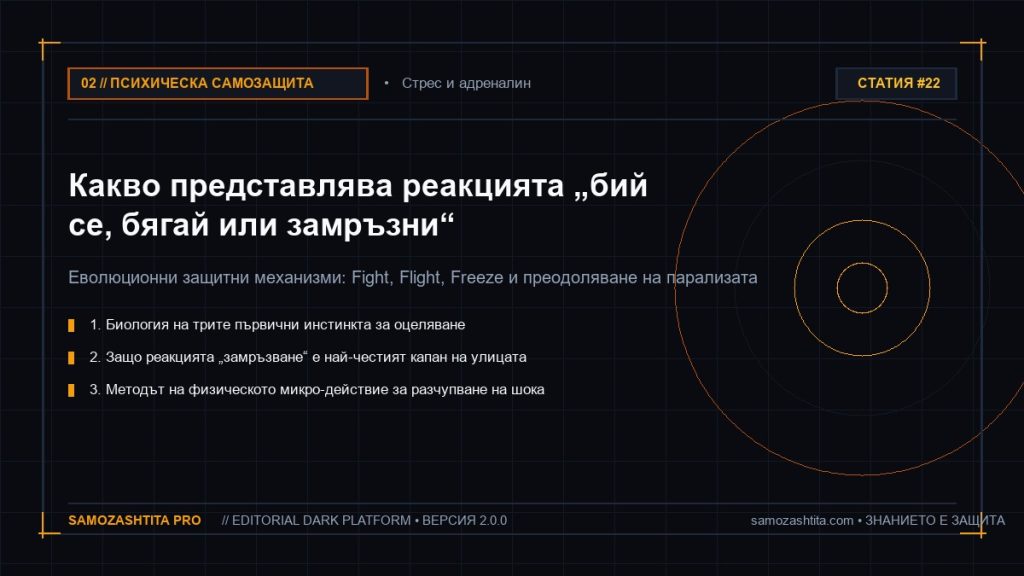
Most people are familiar with the formula ‘Fight or Flight’, but in real-world practice, a third reaction is equally common: Freeze. Understanding why the body locks up in danger is the first step toward overcoming it.
The Hidden Hazard of Freezing
In nature, remaining motionless can save an animal from being spotted by a predator. In modern urban environments, however, the assailant has already noticed you. Freezing works against you, depriving you of the time required to flee or defend yourself.
Freezing occurs when sensory input of an unexpected threat overwhelms the nervous system before a clear action path can be selected. The mind enters a state of cognitive paralysis.
Breaking the Mental Lock
Overcoming the freeze reflex requires intentional physical triggers:
- Initiate Any Physical Motion: Even taking a single step backward, clapping your hands, or shifting weight breaks muscular paralysis. Movement signals the brain that you are an active agent.
- Auditory Self-Command: Shouting a loud, clear verbal directive („BACK AWAY!“ or „NO!“) breaks cognitive shock through vocal motor activation.
- Focus on Immediate Micro-Actions: Direct your mind toward a concrete physical action (reaching the door handle or crossing the threshold).
Key Takeaways:
- Freezing is an evolutionary reflex, not cowardice; it affects untrained individuals involuntarily.
- Any physical movement instantly disrupts psychological immobility.
- Rehearsing responses in advance builds neural pathways that bypass mental paralysis.
