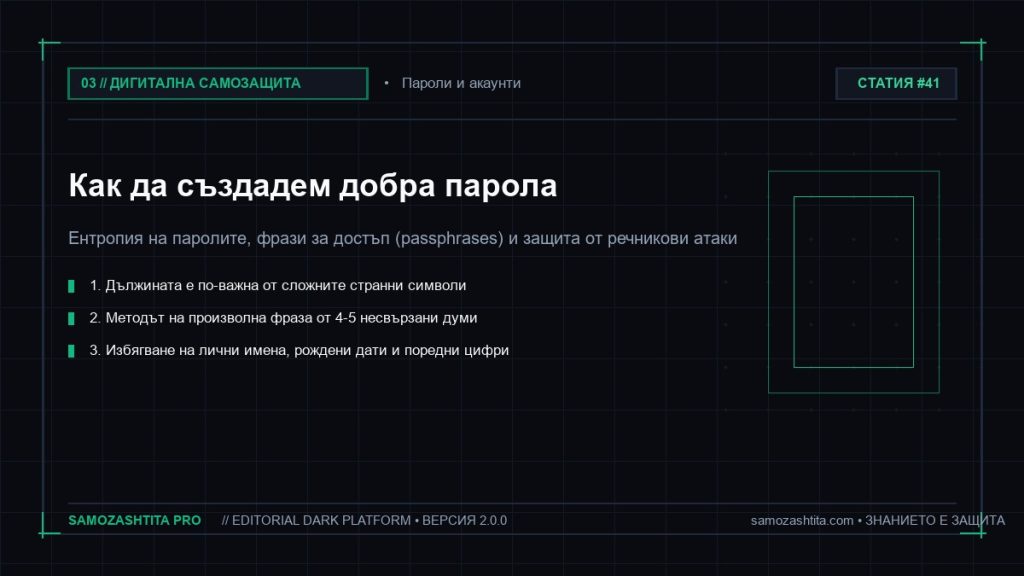
A password remains the primary barrier between your personal life and cyber threats. Yet most individuals create passwords that are easy for computers to crack and nearly impossible for humans to recall.
Why Length Trumps Complexity
In cryptography, password strength is measured by entropy — mathematical randomness. An 8-character password like Tr0ub4dor&3 can be cracked by modern GPU clusters in minutes. In contrast, combining four unrelated dictionary words into a passphrase yields astronomical resistance.
Mathematical entropy scales exponentially with length. Adding characters creates combinatorial resistance that would require supercomputers centuries to brute-force.
The Passphrase Methodology
Combine 4 to 5 randomly chosen, grammatically unrelated words into a single memorable sequence:
- Vulnerable Example:
P@$$w0rd2026!(Artificial complexity, low entropy, easily broken). - Resilient Passphrase:
correct-horse-battery-staple(Over 28 characters, zero memory strain, virtually unbreakable).
Real-World Scenario: Attack on Personal Email
Your primary email is the master key to your entire digital identity — password resets for banks, government portals, and social accounts all pass through it. Protecting this single account with an uncrackable 5-word passphrase like granite-harbor-silent-meadow-timber provides robust immunity against automated credential attacks.
Next Step: The Password Manager
While passphrases are ideal for master access keys, you should never memorize dozens of individual credentials. Combine passphrases with a dedicated password manager to generate unique 24-character random passwords for every secondary service.
Key Takeaways:
- Password length is the single most critical factor in brute-force resistance.
- Passphrases made of unrelated words offer both extreme entropy and human memorability.
- Use a master passphrase for your password manager and primary email account.
