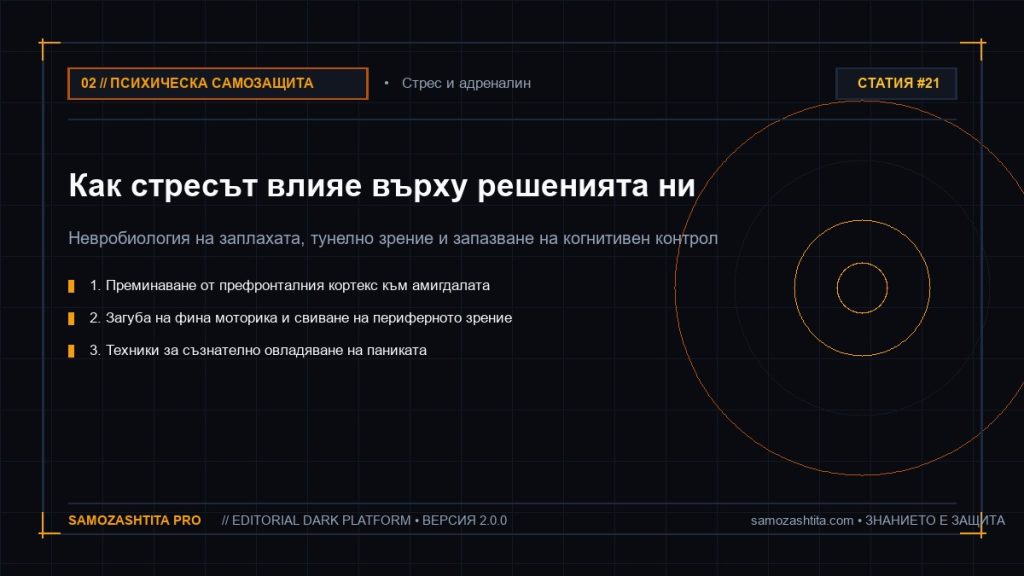
Every individual faced with sudden danger undergoes rapid, dramatic physiological shifts. While these changes are designed to aid physical survival, they often impair the capacity for calm, logical reasoning.
Anatomy of the Acute Stress Surge
In a moment of acute threat, control shifts to the amygdala — an ancient cerebral structure responsible for the instinctive fight-or-flight response. The prefrontal cortex, which governs analysis and planning, is temporarily suppressed.
- Tunnel Vision: Peripheral visual perception narrows drastically; you focus solely on the immediate threat, missing peripheral exits and bystanders.
- Auditory Exclusion: The acoustic cortex filters out ambient background sounds, including spoken words or sirens.
- Motor Degradation: Fine motor skills (such as dialing a phone or manipulating keys) degrade as blood rushes to the major muscle groups.
Real-World Scenario: Searching for Keys at the Entrance
You hear footsteps running behind you in an unlit building hallway. In acute panic, your fingers shake, and you drop your keys repeatedly on the floor. If you understand the physiology of stress, you can pause for a single deep exhalation, steady your hands with your non-dominant thumb, insert the key deliberately, and lock the entrance door.
Preserving Rational Decision-Making
To retain cognitive control under pressure, adopt three fundamental practices:
- Down-Regulate Heart Rate: Practice diaphragmatic breathing (such as box breathing) to stimulate the vagus nerve and slow the pulse.
- Simple Algorithms: Pre-plan simple action sequences („If X occurs, I do Y“) rather than improvising under adrenaline.
- Break the Tunnel: Consciously turn your head left and right to forcefully expand visual awareness.
Key Takeaways:
- Stress is a physiological event, not a failure of will.
- Tunnel vision conceals escape corridors unless actively countered.
- Simplicity saves lives: establish straightforward contingency plans before crisis strikes.
